Grass Carpet for Floor: Where Green Carpet Works Indoors and Out

A grass carpet for floor use is no longer only a balcony product. Green carpet now shows up in living rooms as a play surface, in shops and cafés as a feature floor, in offices behind reception desks, and on terraces where a real lawn would never survive. The question is not whether it works — it is which version works where.
This guide covers the indoor and outdoor uses that genuinely hold up, the thickness to choose for each, and the two situations where you should pick something else entirely.
Quick answer
Green grass carpet works on balconies, terraces, kids' play areas, event floors, shop displays and feature walls. Use 25mm indoors and for décor, 35–40mm outdoors and for play areas. It does not belong in kitchens, bathrooms or anywhere that stays wet. Rolls are 6.5 ft wide and start at ₹1,549.
What makes grass carpet different from an ordinary rug
Three things, and they explain every use case below.
- The backing drains. Perforated latex backing lets water pass straight through instead of soaking into the fibre. That is why it survives outdoors when a normal carpet cannot.
- The fibre is synthetic and UV-treated. Sun fades ordinary dyes. Grass yarn is built to sit in daylight.
- It cuts cleanly. You can shape it around a drain, a pillar or a planter with a blade, which no woven carpet allows.
Outdoor uses
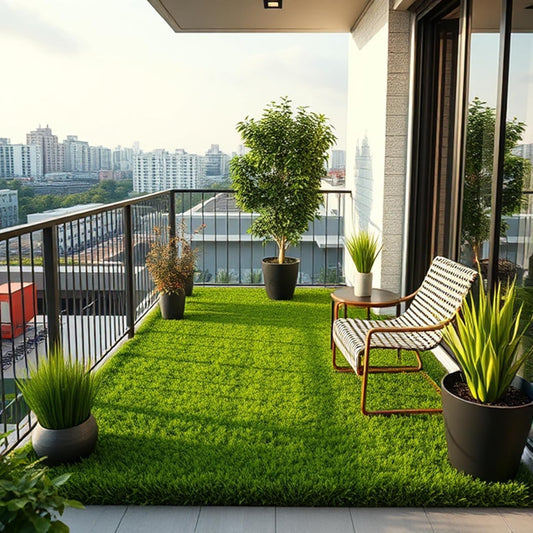
Balcony floors
The most common use, and the one that changes a home the most. A balcony with bare tiles gets walked through; a balcony with grass gets sat on. Choose 35mm or 40mm for comfort underfoot, keep the drain clear, and tape the edges rather than gluing the whole area. Full detail is in our artificial grass collection.
Terraces and rooftops
Larger areas justify 40mm or 50mm, where the taller pile reads as a real lawn from a distance. Because rolls are 6.5 ft wide, a big terrace needs multiple pieces — lay them with the pile leaning the same way so the seams disappear.
Garden patches that never grow
Shaded side strips where real grass refuses to survive are ideal candidates. Clear the surface, level it roughly, and lay the grass over it. The visual difference is immediate and the maintenance drops to nothing.
Around pots and planters
Grass carpet as a base under a plant arrangement hides pot bases, plastic trays and drainage plates. Cut circles out for larger pots and the whole corner looks intentional.
Indoor uses that actually work
Kids' play areas
A green floor is instantly a play surface. It is softer than tile, easy to wipe, and children treat it as a designated zone. Use 35mm — soft enough to sit on, short enough to clean easily.
Feature walls and panels
This is where 25mm earns its place. Short pile lies flat against a vertical surface and takes light evenly, which is why you see it behind reception desks, in café corners and in photo backdrops. It cuts to shape and staples or sticks cleanly.
Shop and showroom displays
Green carpet under a product display separates it from the rest of the floor without building anything. It is also cheap enough to replace when a display changes.
Event and function floors
Weddings, exhibitions, temporary stalls — grass rolls out, gets used for two days and rolls back up. It survives being lifted and re-laid far better than any woven carpet.
Indoor green corners
If the look you want is green texture rather than lawn, our moss carpets give a softer, more decorative finish that suits indoor walls and shelves better than grass does.
Tell us the space and we will pick the thickness
Balcony, terrace, play area, wall panel or display — each needs a different pile height. Send the measurements and the use, and we will tell you exactly what to order from the grass carpet range.
Which thickness for which floor
| Use | Thickness | From |
|---|---|---|
| Wall panels, displays, doormats | 25mm | ₹1,549 |
| Balconies, indoor play areas | 35mm | ₹1,799 |
| Terraces, seating areas, pets | 40mm | ₹1,999 |
| Large lawns and landscaping | 50mm | ₹2,599 |
Where not to use grass carpet
- Kitchens. Oil splatter sits in synthetic pile and is genuinely hard to remove.
- Bathrooms and wet areas. Water drains through, but the floor underneath stays damp, which eventually smells.
- Under heavy fixed furniture that never moves — the pile compresses permanently in those spots.
- As a whole-house floor covering. Green everywhere stops reading as a feature and starts reading as a mistake.
Laying it on an indoor floor
- Clean and dry the floor completely. Any grit will be felt through the backing.
- Unroll and leave the piece flat for a few hours so roll creases relax.
- Dry-fit, mark from the back, and cut along the stitch lines with a sharp blade.
- Fix with double-sided tape at edges and joins. Indoors you rarely need adhesive across the whole area.
- Brush the pile upright once it is down — this is what makes it look installed rather than laid.
Cleaning a green carpet floor
Indoors: vacuum with suction only, and wipe spills with a damp cloth. Outdoors: rinse with water, brush the pile upright, and lift the mat twice a year to clean the floor beneath. For pets, rinse the area and use an enzyme cleaner occasionally rather than plain soap.
Avoid strong solvents and bleach on any synthetic grass. They strip the colour and weaken the fibre. For a broader technical background on how synthetic turf is built, see this reference on artificial turf.
How long does it last on a floor?
Indoors, where there is no UV exposure and no rain, grass carpet lasts a long time — the limiting factor is compression in walking paths rather than the fibre itself. Outdoors, UV treatment and density decide the lifespan. In both cases, brushing the pile upright occasionally is the single habit that keeps it looking new.
Fixing it down: indoors versus outdoors
How you secure grass carpet depends entirely on where it sits, and over-fixing is the most common error.
Indoors, grass rarely needs more than double-sided tape at the edges. The floor is level, there is no wind, and you will want to lift the piece occasionally to clean under it. Gluing an indoor installation down permanently makes that impossible and damages the floor when it eventually comes up.
On a sheltered balcony, tape at the corners and along any exposed edge is enough. The weight of the grass does most of the work.
On an open terrace or rooftop, wind is the real force to plan for. Use adhesive along the perimeter and seam tape where two pieces meet, and consider an edge strip to stop the border lifting. Leave the drainage path clear at every stage.
On a wall or vertical panel, use 25mm and fix with adhesive plus staples or battens depending on the surface. Tall pile hangs and looks heavy on a wall; short pile stays flat and takes light evenly.
What it costs for different spaces
Because grass is sold by running length off a 6.5 ft wide roll, it is easy to estimate once you know your dimensions.
- Small balcony strip (about 6.5 × 5 ft) — one short piece, the lowest-cost option in any thickness.
- Standard apartment balcony (6.5 × 8 to 6.5 × 10 ft) — a single piece, no joins.
- Kids' play corner indoors (roughly 6.5 × 6 ft) — one piece of 35mm, cut to shape around furniture.
- Terrace 13 × 10 ft — two pieces of 6.5 × 10 laid with matching pile direction.
- Feature wall behind a desk — 25mm cut to the panel size, usually far less material than people expect.
Combining grass with planters and decking
Grass carpet works particularly well as the connecting surface between other elements. Wooden deck tiles in the seating area with grass around them, or grass as the floor with a row of tall planters along the railing, both look more designed than either material used alone.
If you are combining materials, keep the grass as the larger continuous surface and let the other element sit on top of it. The reverse — small grass patches between other flooring — tends to look patchy rather than planned.
Frequently asked questions
Can grass carpet be used indoors?
Yes — in play areas, on feature walls, in shop displays and event floors. Use 25mm for vertical and décor work and 35mm for floors people sit on. Keep it out of kitchens and bathrooms.
Which grass carpet is best for a floor?
For an indoor floor, 35mm gives the best balance of comfort and easy cleaning. For an outdoor floor or terrace, 40mm or 50mm looks more natural and handles footfall better.
Does green grass carpet fade in sunlight?
UV-stabilised grass holds colour well outdoors. Untreated cheap yarn fades unevenly within a season, which is the main reason to avoid the lowest-priced rolls.
Is grass carpet safe for children and pets?
Yes. It is softer than tile, does not become slippery when damp the way polished stone does, and rinses clean. Choose 35mm or 40mm for cushioning.
How do I cut grass carpet to fit my floor?
Turn it over and cut from the backing with a sharp utility blade, following the stitch lines. Cut slightly oversize, dry-fit, then trim the edges.
What does grass carpet cost?
From ₹1,549 for 25mm up to larger 50mm rolls. All rolls are 6.5 feet wide and cut to the length you need.
Green floor, no maintenance. Browse the full grass carpet range — 25mm, 35mm, 40mm and 50mm, cut to size and delivered across India. Or see and feel it at our Delhi store.
Tags:
Related articles
-
Oct 07 2026
Round Carpets: Where They Work and What Size to Buy
-
Oct 03 2026