Grass Mat Thickness Explained: 25mm, 35mm, 40mm or 50mm?

Every grass mat listing shouts a number at you — 25mm, 35mm, 40mm, 50mm — and almost none of them explain what that number changes in real life. It is the single most important choice you will make, because it decides how the grass feels underfoot, how natural it looks, and how much you pay.
Here is the plain-language version, based on what customers actually come back and tell us after living with each thickness.

Quick answer
Pick 25mm for doormats, décor and narrow strips, 35mm for everyday balconies, 40mm for terraces and spaces you sit on, and 50mm when you want a genuine lawn look. Prices start at ₹1,549 (25mm), ₹1,799 (35mm), ₹1,999 (40mm) and ₹2,599 (50mm). All rolls are 6.5 ft wide and cut to your length.
What the millimetre number actually measures
The number is the pile height — how far the synthetic blades stand up from the backing. A 40mm grass mat has blades roughly four centimetres tall.
Taller blades do three things. They feel softer, because there is more material to compress under your foot. They look more like real grass, because real grass is not flat. And they cost more, because more yarn goes into every square foot.
What the number does not tell you is density — how many blades are packed into that area. Two mats at the same height can feel completely different. That is why the thickness decision comes first, and the quality check comes second.
The four thicknesses, compared
| Thickness | Feel | Looks | From |
|---|---|---|---|
| 25mm | Firm, flat | Neat, trimmed-lawn effect | ₹1,549 |
| 35mm | Noticeably softer | Natural from standing height | ₹1,799 |
| 40mm | Cushioned, sit-on comfortable | Convincing at close range | ₹1,999 |
| 50mm | Plush, springy | Closest to a real maintained lawn | ₹2,599 |
25mm: the practical workhorse
This is what each grass mat thickness costs per square foot, and what each one is genuinely good for.
| Thickness | Per sq ft | Suits |
|---|---|---|
| 25mm | ₹38 – ₹44 | Balcony display, door mats, shop windows |
| 35mm | ₹42 – ₹51 | Balconies with light footfall, small terraces |
| 40mm | ₹40 – ₹62 | Daily use, play areas, roof gardens |
| 50mm | ₹55 – ₹80 | Lawn look, events, premium terraces |
Short pile has one big advantage people overlook — it is easy to work with. It cuts cleanly into odd shapes, lies perfectly flat, and can be lifted and re-laid repeatedly without the blades splaying.
That makes it the right pick for doormats, narrow balcony strips, shop displays, event décor, wall panels and photo backdrops. It is also the choice when the grass sits under furniture that gets moved a lot, because there is less pile to flatten.
What it will not do is feel luxurious. If you plan to sit on the floor, skip 25mm.
35mm: the sensible balcony default
The jump from 25mm to 35mm is the most noticeable one in the whole range for the smallest extra cost. The grass suddenly has some give, the blades lean naturally instead of standing rigid, and from standing height it reads as a lawn.
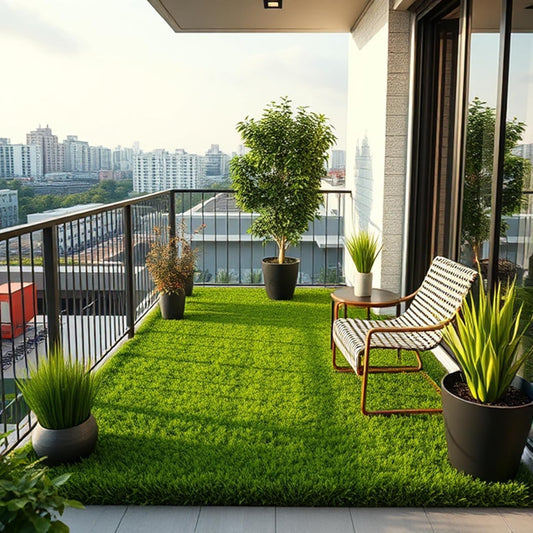
For a typical apartment balcony where people stand, hang plants and occasionally sit, this is the thickness we recommend most often. It is also easier to clean than taller pile, because dust does not sink as deep.
40mm: the one most people end up buying
If your grass area is somewhere you actually spend time — a terrace with chairs, a kids' play corner, a pet area — 40mm is worth the small step up. The extra pile gives real cushioning, and the density in this range is usually high enough that the mat recovers its shape after furniture is moved.
It is also the thickness that photographs best, which matters more than it sounds if you are doing up a rooftop or a café corner.
50mm: when the grass is the feature
The tallest pile we stock. Walking on a well-made 50mm mat barefoot is genuinely close to a real lawn, and in a large open terrace the difference from 40mm is visible.
Two honest caveats. First, taller pile needs occasional brushing to stay upright, especially along walking paths. Second, on a very small balcony the scale can look slightly odd — tall grass in a tiny space reads as artificial. Use it where there is room for it to make sense.
Not sure which to pick?
Tell us what the space is used for — standing, sitting, kids, pets, décor — and the size, and we will tell you the thickness and roll length. See everything in the artificial grass collection, cut to size and delivered across India.
Thickness is not the same as quality
This is where the money is quietly saved by cheaper sellers. A 40mm mat with low density has tall blades with gaps between them — it looks thin from above and flattens within a season. A 35mm mat with good density will outlast it comfortably.
Four checks that reveal quality in a listing:
- Colour build. Look for three or four tones — green, olive and a brown thatch at the base. Uniform bright green is the tell-tale sign of cheap yarn.
- Blade shape. Good grass has curled or textured blades that catch light differently. Flat ribbon blades look plastic.
- Backing. It should be firm with visible drainage perforations, not thin and papery.
- Recovery. Ask how the mat behaves after compression — quality grass springs back when brushed.
For a neutral technical background on construction and pile, see this overview of artificial turf.
How thickness affects the total you pay
Because grass is sold by running length off a 6.5 ft wide roll, the thickness difference multiplies with area.
- On a small doormat piece, the gap between 25mm and 40mm is a few hundred rupees — buy the thicker one.
- On a 6.5 × 10 ft balcony, the gap becomes meaningful but still modest relative to the comfort gained.
- On a large terrace, the same jump can be several thousand rupees, which is where the decision deserves real thought.
A practical rule: spend on thickness where feet actually land, and save on thickness in decorative or low-traffic zones. There is no rule that says one balcony must use one thickness throughout.

Does thicker grass last longer?
Not automatically — density and UV treatment matter more for lifespan. But thicker grass hides wear better, because there is more pile to redistribute. A flattened patch in 25mm is obvious; the same compression in 40mm is barely visible once brushed.
Whatever thickness you choose, the maintenance is the same: brush the pile upright occasionally, rinse off dust, and lift the mat twice a year to clean the floor underneath.
Indoor uses for grass mats
Grass is not only an outdoor product. A 25mm mat makes a striking wall panel behind a desk or a reception counter, and short-pile grass works well as a base for indoor plant displays. If you want the green effect indoors with a softer, more decorative texture, our moss carpets are made for exactly that.
How thickness changes the way you order
Thickness does not only affect comfort — it affects how the roll behaves when you lay it.
Short pile at 25mm is stiffer and holds a flat line, which is why it is easier to fit into a narrow strip or around an awkward corner. Taller pile at 40mm and 50mm is heavier and drapes more, so it settles into an uneven floor better but takes longer to relax out of roll creases. Leave a 50mm piece flat in the sun for a few hours before you cut it.
Joins are the other difference. On 25mm grass a seam is almost invisible because the blades are short and uniform. On 50mm, the pile direction on either side of the join must match, or you will see a line every time the light changes. If your space is wider than the 6.5 ft roll and you want the tallest pile, plan the join along the least-walked edge.
What most customers actually order
Across the orders we ship, the pattern is consistent:
- Apartment balconies — 35mm, usually a single 6.5 × 8 or 6.5 × 10 piece.
- Terraces and rooftops — 40mm, in two or three pieces laid side by side.
- Doormats, shop displays and wall panels — 25mm, cut to shape.
- Large landscaped areas and photo-heavy spaces — 50mm.
If you are torn between two thicknesses, the practical tiebreaker is simple: will anyone sit or lie on this surface? If yes, go thicker. If it is purely visual or walked over quickly, the thinner option saves money without any real loss.
Mixing thickness in one project
There is no rule that a space must use one pile height throughout. A common and sensible combination is 40mm in the seating zone of a terrace and 25mm along a service strip or around planters, where nobody sits and the thinner grass is easier to cut around obstacles. Keep the colour family consistent between the two so the change reads as deliberate rather than accidental.
Grass mat options at every thickness
Each grass mat below states its thickness in the title, so you can match it straight to the table above.


Free shipping
Across India, taxes included
Dispatch in 24 hours
Business hours; custom sizes 5–7 days
100% handcrafted
Woven in Bhadohi, not machine printed
50,000+ customers
Six years of direct selling

Which grass mat thickness suits you?
Looked at more than walked on, take 25mm. Walked on every day, take 40mm or 50mm. Call us if the floor is uneven.
Frequently asked questions
Which grass mat thickness is best for a balcony?
35mm for general use, 40mm if you sit on the floor or have children and pets. Both look natural and feel comfortable barefoot.
Is 50mm artificial grass worth the extra cost?
On a large terrace or rooftop, yes — it gives the closest thing to a real lawn. On a small balcony the scale can look out of place, and 40mm is the better value.
What is the cheapest grass mat option?
Our 25mm range starts at ₹1,549 for the smallest cut. It suits doormats, narrow strips and décor rather than lounging space.
Does thicker artificial grass get hotter in the sun?
All synthetic grass warms in direct afternoon sun. Thickness makes little difference; shade and a quick rinse make a lot.
Can I mix thicknesses in one space?
Yes, and it is often smart — thicker grass in the seating area, thinner grass in a passage strip. Keep pile direction consistent where pieces meet.
How wide are your grass rolls?
All rolls are 6.5 feet wide, cut to whatever length you need. Anything narrower is trimmed from the width.
Pick your thickness and get started: 25mm · 35mm · 40mm · 50mm. Cut to size, delivered across India — or feel the difference yourself at our Delhi store.
Written by the Carpet Planet team. We have sold handcrafted carpets direct from Bhadohi since 2020, to more than 50,000 homes across India, and we see which sizes and materials come back and which do not. Questions on a specific room? Visit us at C-74, Shivalik Road, Malviya Nagar, New Delhi, or call +91 98915 06789.
Tags:
Previous
Artificial Grass for Balcony: Cost, Installation and Maintenance
Next
Room Carpet Guide: Choosing the Right Rug for Every Room at Home
Related articles
-
Oct 07 2026