Room Carpet Guide: Choosing the Right Rug for Every Room at Home

The phrase room carpet covers everything from a rug beside your bed to a piece that anchors an entire hall — which is why generic advice rarely helps. What suits a drawing room is wrong for a kitchen, and what works in a child's bedroom will not survive a dining area.
This guide goes room by room. For each one you get the size that works, the material that lasts, and the mistake people most often make there.
Quick answer
For a living or drawing room, use 6×9 ft with the sofa's front legs on the rug. For a bedroom, 8×11 ft under the bed or two 2×6 ft runners. For a hall or passage, a runner. For dining, add 24 inches around the table and choose a flat weave. Carpets at Carpet Planet start at ₹2,399.

Start with the job, not the design
Before looking at a single photograph, answer three questions about the room:
- Who walks here, and how often? A passage takes twenty times the footfall of a bedside.
- Does anything get spilled here? Food and drink change the material decision completely.
- Do people sit on the floor? In many Indian homes the answer is yes, and that pushes you towards softness over practicality.
Answer those and the shortlist writes itself. Skip them, and you end up with a beautiful carpet in exactly the wrong room.
Living room and drawing room
This is the room most people mean when they search for a carpet, and it is where size matters more than anything else.
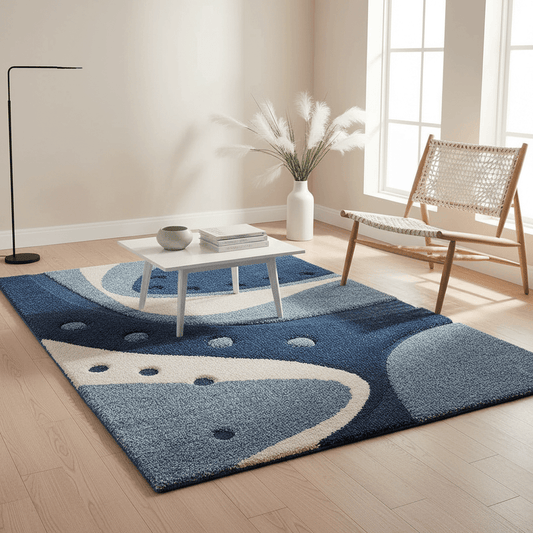
Size: 6×9 ft for a standard 3+2 sofa set, 8×11 ft for a large hall or an L-shaped sofa. Place it so the front legs of the seating rest on the carpet — that single rule makes the furniture look like a deliberate group instead of pieces pushed against walls.
Material: hand-tufted wool blends for longevity, microfibre shag if the family sits on the floor. In a drawing room used mainly for guests, you can afford a lighter colour and a finer pile because traffic is low.
Common mistake: buying one size too small because it fit the budget. A 4×6 ft rug floating in a large room reads as an accident. Browse the living room carpet range, where sizes are listed on every product.
Bedroom
Size comes before material in every room. Use this as your room carpet sizing reference.
| Size | Room | How it sits |
|---|---|---|
| 3 × 5 ft | Bedside, entryway | Beside the bed, or just inside the door |
| 5 × 7 ft | Small living room, 10 × 12 ft | Front legs of the sofa resting on it |
| 6 × 9 ft | Standard living room, 12 × 15 ft | Sofa and chair front legs on it |
| 8 × 10 ft | Large living room, queen bed | All furniture legs fully on it |
| 9 × 12 ft | Big hall, king bed | The whole seating group sits inside |
Size: 8×11 ft if you want the carpet under the bed and extending on three sides; 6×9 ft for the two-thirds placement that starts below the pillows. In compact bedrooms, two 2×6 ft runners on either side cost far less and put softness exactly where your feet land.
Material: this is the one room where comfort should win outright. Shaggy and high-pile carpets are ideal because traffic is low and nobody eats on the floor. See bedroom carpets and shaggy rugs.
Common mistake: placing the carpet only at the foot of the bed. It looks fine in photographs and does nothing for you in real life, because you step out at the sides.
Hall and passage
Size: a runner, 2×6 ft to 2×12 ft depending on the corridor. Leave four to six inches of floor visible on each side — a runner that touches both walls looks like failed wall-to-wall carpeting.
Material: low pile, flat weave, mid-tone colour. This is the highest-traffic strip in the house and the one that shows dust fastest. Our runner carpets are made for this.
Common mistake: using a soft, light-coloured rug in a passage. It will look tired within a season.
Dining area
Size: measure the table and add 24 inches on every side, so chairs stay on the carpet when pulled out. A six-seater of about 3×6 ft needs roughly 7×10 ft.
Material: flat weave or low-pile only. Spills are inevitable, and you need a surface you can wipe rather than excavate. Avoid shag entirely here.
Common mistake: a rug that ends exactly where the chairs sit. Every meal becomes a small wrestling match and the binding wears out at the edge.
Kids' room
Size: a 4×6 ft or a small round rug in the play zone works better than wall-to-wall coverage, because you can lift and clean it.
Material: washable or easy-clean, always. Soft enough to sit on, low enough to vacuum properly. Round shapes have no corners to trip over. See kids room carpets.
Common mistake: choosing deep shag for a play area. It looks wonderful for two weeks and then holds every crumb and crayon shaving.
Tell us the room and we will size it for you
Send the room dimensions and what happens in it — sitting, dining, kids, guests — and we will recommend the size and material. Browse carpets for every room at Carpet Planet, delivered across India.
Balcony and terrace
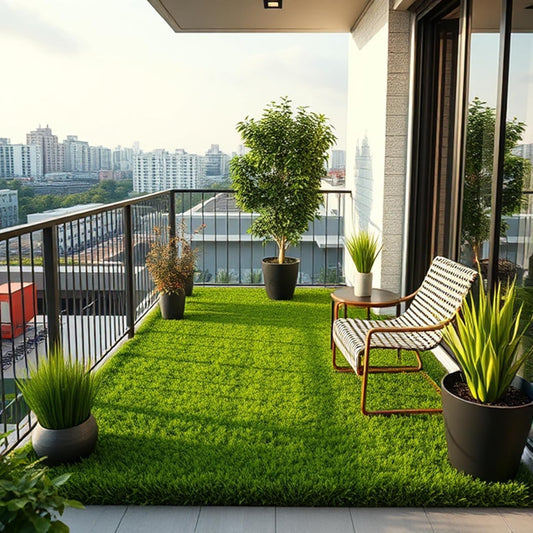
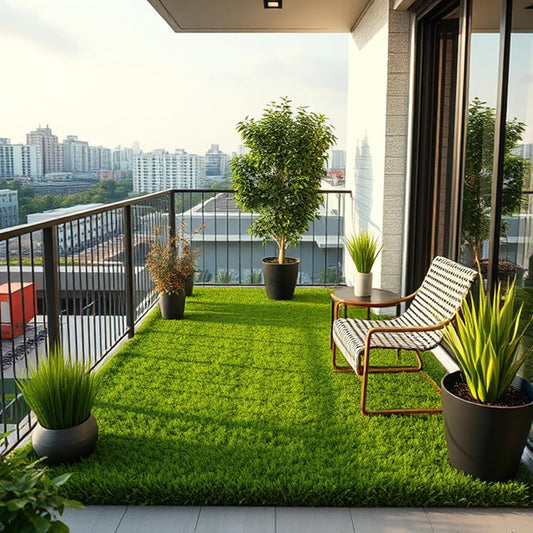
Ordinary carpets do not belong outdoors — they hold water and fade. Use artificial grass instead, which is designed to drain and handle sun. It starts at ₹1,549 and turns an unused balcony into a place people actually sit.
Entryway
Size: small — 3×5 ft, or a 4 ft round under a central light. Check the door clears the pile before you buy.
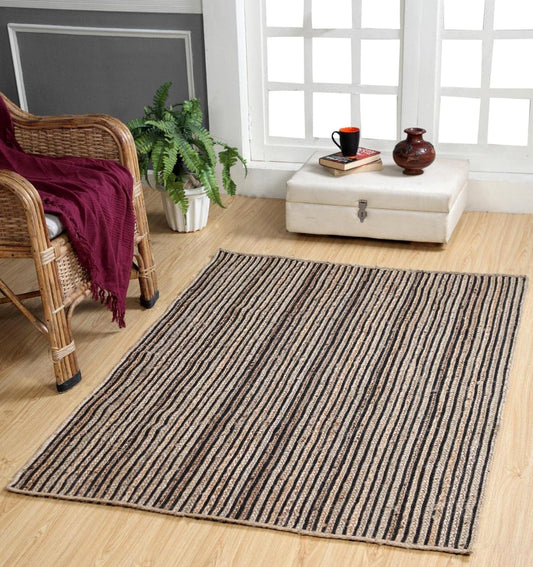
Material: jute or a tough flat weave. This is where outdoor dust arrives, so choose something that hides it and can be shaken out. See jute rugs.
Study and home office
Size: large enough that the chair stays on the carpet through its full range of movement — otherwise the wheels catch the edge repeatedly.
Material: low pile. Chair castors and deep pile are a bad combination, and a flat surface is kinder to a rolling chair.

One carpet, or several?
In open-plan homes people often try to solve everything with one enormous carpet. Two or three correctly sized rugs almost always work better: they define zones, they cost less in total, and you can replace the one that takes the most punishment without touching the others.
If you want visual continuity across zones, repeat one element — the same colour family, or the same texture — rather than the same rug.
Budget: where to spend and where to save
Spend where you feel it and see it: the living room and the bedroom. Save in the passage, the entry and the study, where a simple flat weave does the job and will be replaced sooner anyway.
Our range starts at ₹2,399 for carpets and ₹1,549 for grass mats, so a whole-home refresh does not have to happen at once. Start with the room you use most.
For a general background on carpet types and construction, this neutral reference on carpets is a useful read.
Care, room by room
- Living room: vacuum weekly, rotate every few months, use a rug pad.
- Bedroom: shake out monthly; dust settles more than you think in a low-traffic room.
- Passage: vacuum twice a week — this is where grit does the real damage.
- Dining: blot spills immediately, never rub.
- Kids' room: choose something you can actually wash, and then wash it.
Colour, room by room
Colour choices that work in one room fail in another, and the reason is usually light and traffic rather than taste.
- Living and drawing room: mid-tones are the safest — they hide everyday marks and still lift the floor. If the sofa is dark, go lighter; if the sofa is light, go deeper. Never match the two exactly.
- Bedroom: you can afford soft, pale shades here. Traffic is low and the room usually has less direct sun.
- Hall and passage: mid to dark, patterned if possible. Footfall and dust arrive here first.
- Dining: patterns are your friend. A textured or printed surface disguises the small marks that a plain carpet displays perfectly.
- Kids' room: bright is fine, but choose colours that survive washing rather than delicate pastels.
One practical habit: look at the carpet colour in the room's own light before deciding. The same rug reads warmer under yellow bulbs and cooler under white LED light, and daylight changes it again.
Layering in rooms that need two things at once
Some rooms need coverage and comfort at the same time — a living room where children play, or a bedroom that doubles as a study. Layering solves it. Put a large flat rug down as the base, then a smaller soft rug on top where people actually sit.
The base handles size and durability; the top layer handles comfort and can be washed or swapped without replacing everything. A jute base under a shaggy rug is the pairing that works most reliably.
A quick checklist before ordering for any room
- Measure the furniture grouping, not the floor.
- Tape the outline on the floor and live with it for a day.
- Check the door clears the pile height.
- Decide whether this room needs washable, and be honest about it.
- Add a rug pad — it belongs in every room with a hard floor.
If you are furnishing more than one space at once, buy the living room piece first. A room carpet there sets the colour everything else answers to, and a smaller room carpet is far easier to match afterwards than the other way round.
Room carpet choices, room by room
These are our most asked-for pieces across the four rooms. Each room carpet listing gives the sizes it comes in.


Free shipping
Across India, taxes included
Dispatch in 24 hours
Business hours; custom sizes 5–7 days
100% handcrafted
Woven in Bhadohi, not machine printed
50,000+ customers
Six years of direct selling

Shop your room carpet by room
Living room, bedroom, dining and kids, sorted so you can start from the room rather than the rug.
Frequently asked questions
What size carpet is best for a room?
It depends on the furniture, not the floor. For a living room with a 3+2 sofa, 6×9 ft. For a bedroom, 8×11 ft under the bed or two 2×6 ft runners. For a passage, a runner with a few inches of floor showing on each side.
Which carpet is best for a drawing room?
A hand-tufted wool blend in 6×9 ft or larger. Traffic is usually lower in a drawing room, so you can choose a finer pile and a lighter colour than you would elsewhere.
Can I use the same carpet type in every room?
You can, but you should not. A dining area needs a flat weave, a bedroom wants softness, and a passage needs durability. Matching colour families across rooms is a better way to keep a home looking coherent.
What carpet works for a hall?
A low-pile runner in a mid-tone. Halls take the most footfall and show dust fastest, so avoid light colours and deep pile.
How much should I spend on a room carpet?
Our carpets start at ₹2,399. Spend more on the living room and bedroom where you see and feel the carpet daily, and less on passages and entryways.
Do I need a rug pad in every room?
Yes wherever the carpet can slide, and especially on tile or polished stone. A pad also cushions the rug and extends its life.
Shop by room: living room · bedroom · kids room · dining room · passage runners · balcony grass. Delivered across India, or visit our Delhi store.
Written by the Carpet Planet team. We have sold handcrafted carpets direct from Bhadohi since 2020, to more than 50,000 homes across India, and we see which sizes and materials come back and which do not. Questions on a specific room? Visit us at C-74, Shivalik Road, Malviya Nagar, New Delhi, or call +91 98915 06789.
Tags:
Previous
Grass Mat Thickness Explained: 25mm, 35mm, 40mm or 50mm?
Next
Round Carpets: Where They Work and What Size to Buy
Related articles
-
Oct 07 2026
Round Carpets: Where They Work and What Size to Buy
-
Oct 03 2026